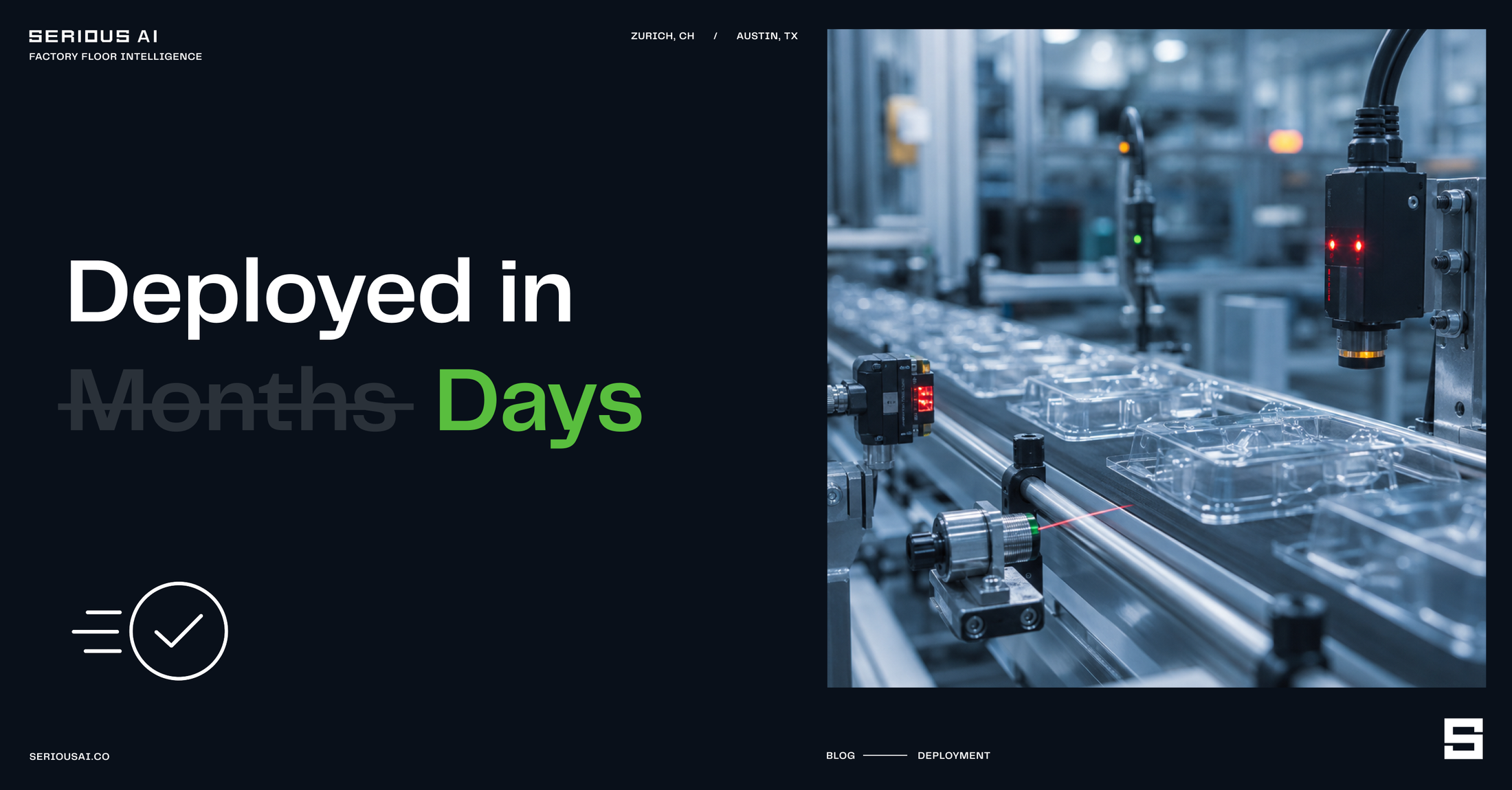
Why we deploy in days, not months
Why Genesis deploys in days, when industrial AI has always taken a year
Every plant manager knows the industrial AI timeline. Twelve months, give or take. A discovery phase, a data project, a pilot, and eventually a dashboard that flags something the line already knew.
The usual explanation blames the overhead around the work. Procurement, security review, change management. That's real. But it isn't where the year went.
The year didn't go where you think
The year went to the work itself. Three pieces of it, and each one took real time. And the reason it took a year is the same reason it never reached the next line or the next plant.
Connecting to the floor
Every floor speaks a dozen dialects at once. OPC UA on the new lines, PROFINET and raw PLC tags on the old ones, MQTT from retrofit sensors, a historian holding a decade of process memory, an MES that thinks in orders and lots. None of them agree on names, units, or timing. Connecting to all of it meant weeks of hand-built integrations, protocol by protocol, device by device, before a single model saw a single signal.
Giving the data meaning
A sensor stream on its own is a column of numbers. It doesn't know which machine it came from, what it measures, or what a normal value looks like. Before any model could reason over it, someone had to encode all of that by hand. What each signal is, how the assets relate, where the line starts and ends. That's an ontology. On a real plant it took months, and it had to be redone the moment you moved to a floor laid out differently.
Training from zero
Then the models. They arrived knowing nothing about production. To predict one failure mode on one asset, you needed a large labeled dataset built from that asset's own history. That's six months or more of collection before the system could say anything useful, and it bought you one prediction on one machine. The next failure mode, the next machine, started the clock again.
And none of it scaled
Now multiply all of that by every factory being different. Different sensors, different protocols, different assets, different data types and modalities. Nothing carried over. Every deployment was a fresh twelve-month project built from scratch.
Your internal team stayed busy the whole time, on work they enjoyed. But none of it compounded. At the end you had a pilot on one line, in one plant, catching some scrap the data science team already suspected. Impressive in the room. Impossible to repeat at speed.
That's where it died. No CFO signs off on a second twelve-month project to recover the next line, when the first one took a year to reach one number. The problem was never that the AI didn't work. It was that it didn't scale.
What Genesis changes
Genesis is built for that problem directly.
We automate connectivity. Point the box at the sources and it generates its own connectors against what's there, reading the namespaces and inferring the schema, instead of us writing each integration by hand. What used to be weeks becomes configuration.
We build the factory context model automatically, in seconds, then review it with your operations team. The system produces the first-pass model of the plant. The people who know the floor correct it, instead of authoring it from nothing. Same result as the hand-built ontology, without the months.
And our models are foundational. Language, vision, and time series, pre-trained to generalize across any asset or sensor. They don't start from zero on your equipment. Grounding them to your plant takes two to three weeks of data to reach a steady state, not six months, and the same models carry to the next asset and the next plant without starting over.
Why days, not months
That's why it's days, not months. Not because we cut the review or skipped the pilot. Because the slow parts were the parts that never scaled, and those are the parts we automated.
And that's the part the CFO cares about. The first deployment proves the number. Every one after it is a copy of something already working, not another leap of faith. The second line isn't a project. It's a rollout.
Related articles
Edge-first AI in manufacturing: AI should live where the data lives.
No plant ever wanted its process data shipped off to a giant cloud company across the world. Build from the floor up, where the work happens — and thanks to how far the hardware has come, you finally can.

You’ve automated the line. You’re still losing output you can’t see.
The next gain on your floor isn’t another machine — it’s acting on what the line already tells you, while the shift is still running.
No one can act on 56 alarms at once — so your operators act on none of them.
Flood a supervisor with alarms and they don’t triage faster — they tune the screen out and run on instinct. The fix isn’t more alerts; it’s one decision they trust.

Factory IntelligenceCohort
We connect, model and deploy a working AI agent on your floor in a week, and scale it up for 1 month — built side by side with your team until it's catching production and quality escapes live.
The first one is on us.
Learn more